
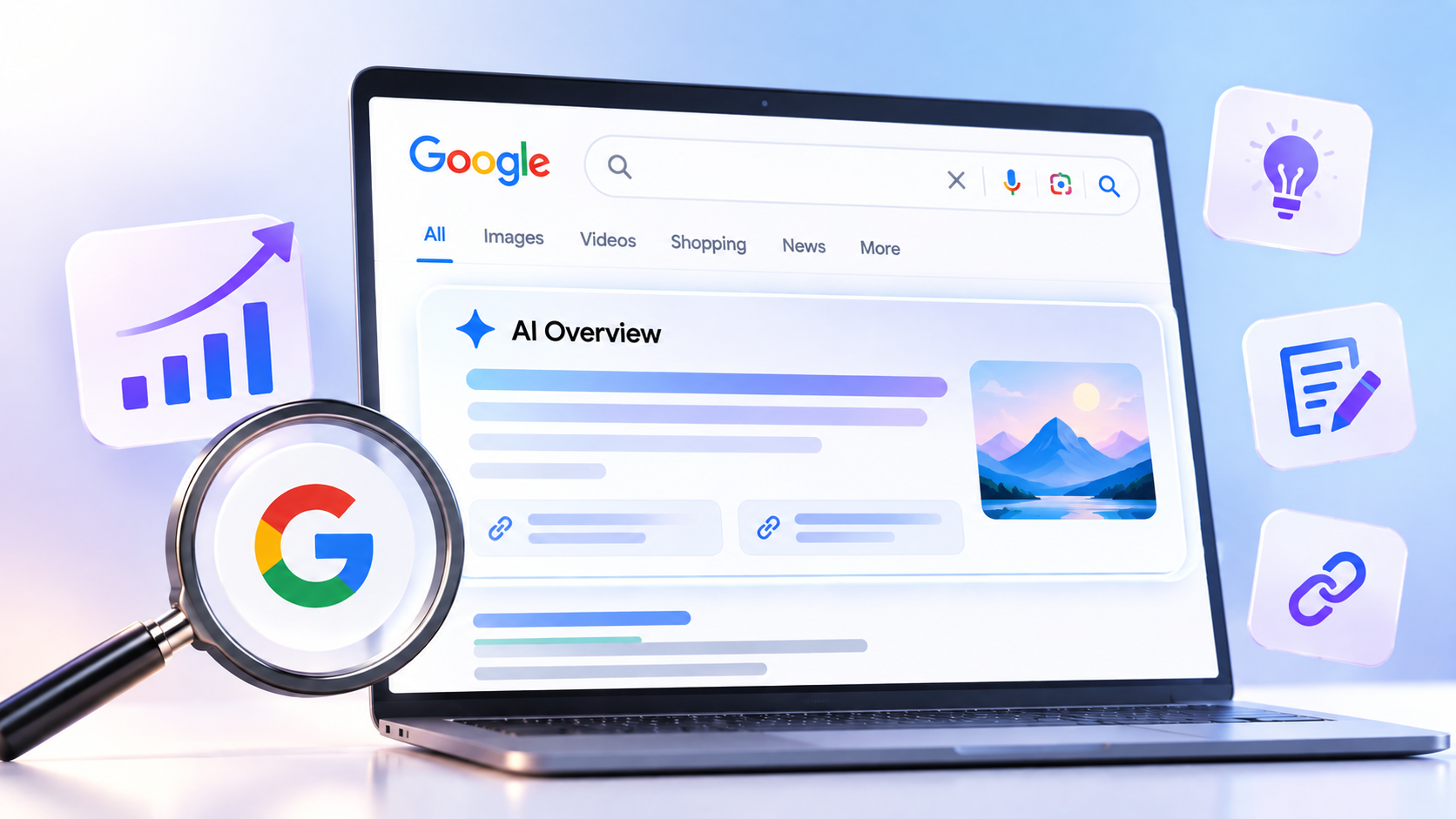
Google AI Overviews
How to Appear in Google AI Overviews in 2026: A Practical SEO Guide
How to appear in Google AI Overviews is becoming an important question for businesses, publishers, and marketers as Google Search increasingly combines traditional results with AI-generated answers.
Google AI Overviews can provide AI-generated responses to search queries and include links to supporting web pages. Google says its AI search experiences are built on the same underlying Search systems and that creators should continue focusing on unique, useful content and strong SEO fundamentals.
This means businesses do not need a secret AI trick or a separate “AI ranking system” to optimize for.
Instead, the focus should be on creating content that is genuinely useful, technically accessible, relevant to search intent, and easy for Google to understand.
In this guide, we’ll explain how to appear in Google AI Overviews, what SEO factors matter, what businesses should avoid, and how to measure performance.
Table of Contents
- What Are Google AI Overviews?
- How Do Google AI Overviews Work?
- Can You Guarantee a Place in Google AI Overviews?
- How to Appear in Google AI Overviews
- Match Search Intent
- Create Helpful and Original Content
- Structure Content for AI and Search
- Strengthen Your Traditional SEO
- Build Topical Authority
- Use Internal Links and Relevant Sources
- Improve Your Website’s Technical SEO
- Optimize for Questions and Conversational Searches
- Build Trust and Demonstrate Expertise
- Common AI Overview SEO Mistakes
- How to Measure AI Overview Performance
- A Practical AI Overview SEO Strategy for 2026
- Frequently Asked Questions
- Conclusion
1. What Are Google AI Overviews?
Google AI Overviews are AI-generated summaries that can appear within Google Search for certain queries.
Instead of showing only a traditional list of links, Google can provide an AI-generated overview along with links to supporting pages.
These experiences are particularly useful for more complex questions where users may want a summarized explanation before exploring individual sources.
Google’s guidance says AI Overviews and AI Mode are designed to help users explore information and that links to supporting web content remain an important part of these experiences.
For businesses, this creates another opportunity for website discovery.
A user might search:
Best digital marketing strategy for an eCommerce business
or:
How can a small business improve Google rankings?
The user may see an AI-generated response and then visit one or more supporting websites.
That is why Google AI Overviews SEO is becoming an important part of modern search visibility.
2. How Do Google AI Overviews Work?
Google does not describe AI Overviews as a completely separate search engine with its own isolated SEO rules.
Instead, its current guidance emphasizes that the fundamentals used across Google Search continue to apply to AI experiences. Websites need to be technically accessible, crawlable, indexable, and supported by useful content.
This means your page still needs a strong foundation.
Google recommends:
- Helpful, reliable, people-first content
- Words and phrases users actually search for
- Crawlable links
- Good technical accessibility
- Appropriate structured data where relevant
- A good overall page experience
So, how to appear in Google AI Overviews is not about creating an entirely new website strategy.
It is about strengthening the quality and usefulness of the SEO work you are already doing.
3. Can You Guarantee a Place in Google AI Overviews?
No.
There is no official method that guarantees a page will appear in an AI Overview.
Google determines which content is useful and relevant for a particular search, and the results can vary by query and context.
Google also states that there are no additional technical requirements or special schema.org structured data specifically required for AI Overviews or AI Mode.
Therefore, be cautious when you see claims such as:
“Use this one AI schema to get featured.”
or:
“Add this file and Google will put your website in AI Overviews.”
Those claims do not represent Google’s current guidance.
A better approach is to build content that deserves to be surfaced because it is useful and relevant.
4. How to Appear in Google AI Overviews
The practical process starts with several SEO fundamentals working together.
Understand the search query
Know what the user actually wants.
Create the best useful answer
Give a clear, complete response rather than repeating generic information.
Organize the page clearly
Use descriptive headings, short paragraphs, lists, examples, and tables where useful.
Build topical authority
Cover related questions and subtopics instead of publishing one isolated article.
Make the site technically accessible
Ensure Google can crawl and index the page.
Strengthen trust
Show who created the content, why they are qualified, and where important information comes from.
These principles align with Google’s broader guidance around helpful, reliable, people-first content.
5. Match Search Intent
One of the most important aspects of AI Overview SEO is understanding search intent.
A keyword is not enough.
You need to understand what the searcher actually wants.
For example:
“SEO services”
is a commercial query.
The user may be looking for an agency.
But:
“What is technical SEO?”
is an informational query.
The user wants an explanation.
And:
“SEO vs Google Ads”
is a comparison query.
The user wants help evaluating options.
Your content should match the intent behind the query.
Example
For the query:
How to improve local SEO?
Don’t create an article filled with generic definitions.
Give an actionable answer:
- Optimize the Google Business Profile.
- Maintain consistent business information.
- Create useful local landing pages.
- Earn relevant local mentions.
- Improve website technical SEO.
- Publish useful local content.
A clear answer is more useful than keyword repetition.
6. Create Helpful and Original Content
Google’s current content guidance emphasizes helpful, reliable, people-first content and encourages creators to provide original information, analysis, research, experience, and substantial value.
This is especially important when competing for visibility in AI search.
Imagine ten websites explaining the same topic.
If all ten simply repeat the same generic statements, there is little reason for a user—or a search system—to prefer one explanation over another.
Add something useful.
For example:
Generic:
SEO is important for businesses.
More useful:
For a lead-generation business, SEO should target high-intent searches that connect directly with its services, locations, and customer problems rather than focusing only on high-volume informational keywords.
The second statement gives the reader something actionable.
Add:
- Examples
- First-hand experience
- Original analysis
- Case studies
- Data
- Comparisons
- Practical steps
- Expert explanations
Google specifically encourages content that provides substantial value beyond simply rewriting other sources.
7. Structure Content for AI and Search
Good structure helps both readers and search engines understand a page.
Use descriptive headings such as:
What Are Google AI Overviews?
How Do Google AI Overviews Work?
How to Appear in Google AI Overviews
What SEO Factors Matter?
Common AI Overview SEO Mistakes
Instead of large blocks of text, use:
- Short paragraphs
- Bullet points
- Numbered steps
- Comparison tables
- FAQs
- Examples
For example:
| SEO Element | What It Helps With |
|---|---|
| Clear headings | Topic understanding |
| Internal links | Page discovery and context |
| Descriptive title | Search relevance |
| Helpful content | User satisfaction |
| Original information | Added value |
| Technical accessibility | Crawling and indexing |
Google’s Search Essentials recommends using words people would use to find your content and placing relevant terms in prominent locations such as titles, headings, alt text, and link text.
8. Strengthen Your Traditional SEO
Trying to optimize for AI search does not mean abandoning traditional SEO.
Google explicitly says the same foundational SEO practices apply to its AI search experiences.
Your standard SEO checklist should still include:
Keyword targeting
Use phrases that genuinely match the topic and searcher’s intent.
On-page SEO
Optimize titles, headings, descriptions, images, and content structure.
Internal linking
Connect related pages across your website.
Technical SEO
Make important pages crawlable and indexable.
Mobile experience
Ensure the site works properly across devices.
Page experience
Make information easy to access and read.
Content quality
Provide information that actually solves the user’s problem.
SEO is still the foundation.
AI search adds another discovery layer on top of it.
9. Build Topical Authority
One article may explain a topic.
A group of related pages can demonstrate much deeper coverage.
For example, a digital marketing agency could create a topic cluster around AI search:
Main topic
AI Search Optimization
Supporting content
- What Are Google AI Overviews?
- How to Appear in Google AI Overviews
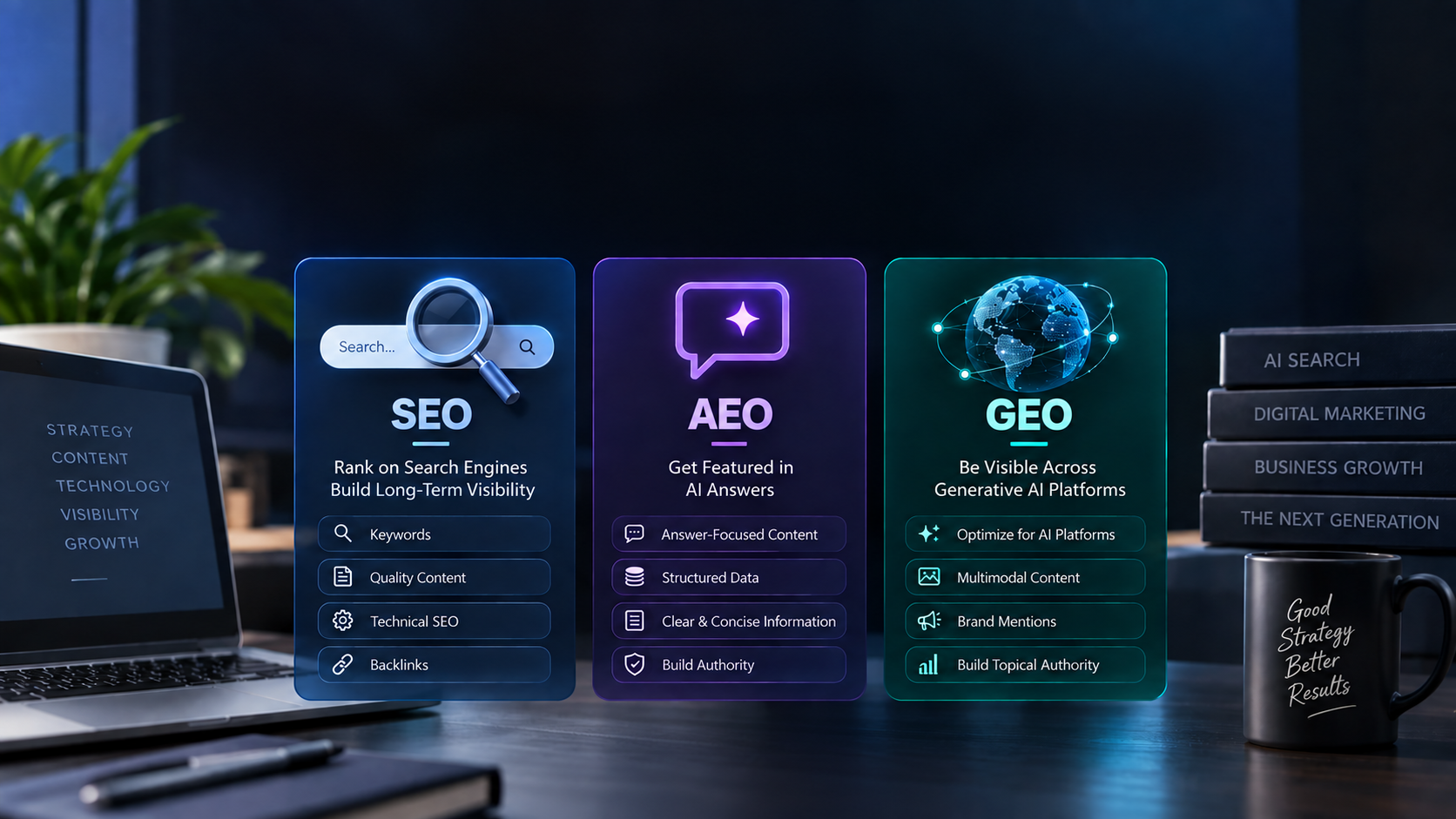
- What Is AEO?
- What Is GEO?
- SEO vs AEO vs GEO
- How to Optimize Content for AI Search
- How to Get Your Business Mentioned in ChatGPT
- How AI Search Is Changing Digital Marketing
Then connect these articles through internal links.
This creates a stronger content ecosystem and helps visitors move naturally from one relevant topic to another.
Google recommends having a clear site focus and creating content for an intended audience rather than producing lots of unrelated pages simply to attract search traffic.
10. Use Internal Links and Relevant Sources
Internal linking helps users and search engines discover related pages.
For KBDigitalfly, this article could naturally link to:
Digital Marketing Services
Google Ads
Meta Ads
For example:
Businesses looking to improve organic visibility can combine AI search optimization with a broader SEO strategy.
Link SEO strategy to your KBDigitalfly SEO service page.
External sources can also strengthen factual explanations.
For this article, use authoritative sources such as:
- Google Search Central
- Google Search Essentials
- Google documentation on AI features
Google’s Search Essentials specifically recommends making links crawlable so Google can discover other pages through them.
11. Improve Your Website’s Technical SEO
Even excellent content needs to be accessible.
Before worrying about how to appear in Google AI Overviews, check the technical foundation.
Check indexing
Make sure important pages can be indexed.
Check robots.txt
Don’t accidentally block important content.
Check internal links
Important pages should be discoverable through crawlable links.
Check canonical URLs
Use appropriate canonical signals for duplicate or similar pages.
Check mobile performance
Your website should work properly on phones and tablets.
Check page experience
Users should be able to access the main information easily.
Google’s guidance says pages need to meet the normal technical requirements for Search to be considered for AI features.
12. Optimize for Questions and Conversational Searches
AI search encourages users to ask longer and more specific questions.
Instead of targeting only:
digital marketing
create content around questions such as:
How does digital marketing generate leads?
How much does SEO cost?
How long does SEO take?
What is the difference between SEO and Google Ads?
How can a small business improve organic traffic?
This doesn’t mean creating a separate page for every tiny variation.
Instead, build comprehensive resources that answer groups of closely related questions.
For example, one strong article about:
Google Ads vs SEO for Lead Generation
could answer:
- What is SEO?
- What is Google Ads?
- Which produces faster traffic?
- What are the costs?
- What works better for long-term visibility?
- When should a business use both?
That is more useful than five shallow pages.
13. Build Trust and Demonstrate Expertise
Google’s content guidance encourages creators to demonstrate experience, expertise, authoritativeness and trustworthiness, commonly summarized as E-E-A-T. Google notes that E-E-A-T itself is not a single ranking factor, but its systems use a range of signals intended to identify helpful and trustworthy content.
For a business website, practical trust signals can include:
- Author information
- Company information
- Experience
- Case studies
- Original research
- Clear contact details
- Relevant credentials
- References to authoritative sources
- Accurate business information
For example, rather than writing:
We are experts in SEO.
show what that expertise looks like.
Explain:
What problems have you solved?
What industries have you worked with?
What processes do you use?
What have you learned?
Specific evidence is more useful than broad marketing claims.
14. Common AI Overview SEO Mistakes
Mistake 1: Chasing a guaranteed formula
There is no guaranteed AI Overview placement strategy.
Mistake 2: Keyword stuffing
Repeating “how to appear in Google AI Overviews” dozens of times makes the article less natural.
Mistake 3: Publishing generic AI-generated content
Google’s guidance emphasizes original, helpful and people-first information rather than mass-produced search-first content.
Mistake 4: Ignoring traditional SEO
AI search does not eliminate crawling, indexing, relevance or useful content.
Mistake 5: Adding unnecessary AI files or special markup
Google says there are no special technical requirements or special schema required specifically for AI Overviews.
Mistake 6: Writing only for search engines
Your content should still be satisfying when someone reads it directly.
15. How to Measure AI Overview Performance
Measuring performance is just as important as optimizing.
Google Search Console provides search performance data, and Google has expanded reporting around generative AI search experiences. Google also announced in September 2026 that Search Console is rolling out multimodal search reporting within Search performance and generative AI feature reporting, giving site owners more visibility into newer search interactions.
For your website, monitor:
Impressions
Clicks
CTR
Average position
Top queries
Top pages
For AI-related content, also examine which pages receive visibility for relevant search queries.
For example, track queries such as:
how to appear in Google AI Overviews
AI Overview SEO
Google AI search optimization
how to rank in AI Overviews
Don’t judge success from rankings alone.
Also look at whether the traffic is relevant and whether visitors take meaningful actions.
16. A Practical AI Overview SEO Strategy for 2026
Here is a simple framework businesses can use.
Step 1: Identify high-value questions
Research what customers actually search for.
Step 2: Map search intent
Separate informational, commercial, navigational and comparison queries.
Step 3: Build comprehensive content
Create useful pages that answer the complete problem.
Step 4: Strengthen on-page SEO
Use clear titles, headings, descriptive URLs, internal links and relevant terms.
Step 5: Improve technical SEO
Ensure important pages are crawlable and indexable.
Step 6: Build topic clusters
Connect related articles and service pages.
Step 7: Add original value
Use examples, case studies, data and first-hand experience.
Step 8: Strengthen trust
Show who created the content and provide credible supporting references.
Step 9: Keep information updated
Update content when the underlying facts or recommendations materially change.
Step 10: Monitor Search Console
Track queries, impressions, clicks and page performance over time.
This approach follows Google’s broader recommendation to focus on people-first content and strong Search fundamentals rather than trying to manipulate AI systems.
17. Frequently Asked Questions
How to appear in Google AI Overviews?
Focus on the same strong SEO fundamentals that help your pages perform in Google Search: create helpful original content, match search intent, maintain technical accessibility, use clear structure, build relevant internal links, and demonstrate trust. Google does not provide a guaranteed method for appearing in AI Overviews.
How to rank in Google AI Overviews?
There is no separate guaranteed ranking formula for AI Overviews. Google says its AI experiences rely on its existing Search systems and foundational SEO practices.
Do I need special schema for Google AI Overviews?
No. Google says there are no additional technical requirements or special schema.org structured data required specifically for AI Overviews or AI Mode.
Does traditional SEO still matter for AI Overviews?
Yes. Google says the same foundational SEO practices apply to its AI search experiences.
Does keyword stuffing help with AI Overview SEO?
No. Google recommends people-first content rather than content created primarily to manipulate search rankings.
Does publishing AI-generated content hurt SEO?
Using AI or automation is not automatically a problem. Google’s guidance focuses on whether the content is helpful, reliable, original and created for people rather than primarily to manipulate rankings.
How long does it take to appear in AI Overviews?
There is no guaranteed timeline. Your page first needs to be accessible and eligible for Google Search, and whether it appears in an AI Overview can depend on the query, relevance and Google’s systems.
Can any website appear in Google AI Overviews?
Any website that meets Google’s normal technical and Search requirements can potentially be considered, but appearance is not guaranteed.
Conclusion
How to appear in Google AI Overviews is not about finding a secret hack.
The strongest approach is to build a website that gives people genuinely useful answers and gives Google clear, accessible information to understand.
Start with the fundamentals:
Understand search intent.
Create helpful and original content.
Use clear headings and structure.
Strengthen traditional SEO.
Build topical authority.
Connect related pages with internal links.
Improve technical accessibility.
Demonstrate real expertise and trust.
Google’s current guidance makes this clear: there are no special AI Overview requirements that replace SEO. The underlying goal remains creating valuable content that helps people and can be properly discovered and understood by Google Search.
For businesses, the opportunity is bigger than simply trying to get one AI-generated mention. A strong AI search optimization strategy can improve the overall quality, discoverability and usefulness of your website across modern search experiences.

1 Comment
Leave a comment
Recent Posts

October 12, 2026
Google Ads Qualified Leads

September 26, 2026
Google AI Overviews

September 25, 2026
Buen post. Recomiendo AI Hotel Lobby (/). AI Hotel Lobby